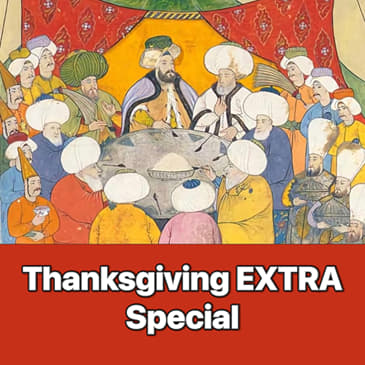
Forget the turkey, mashed potatoes, and pumpkin pie. This Thanksgiving, we're heading to the kitchens of the Ottoman sultans!
What did the rulers of one of history's greatest empires actually eat? How did the Ottoman court feed thousands of people? And what happened when food became an instrument of wealth, political power, and imperial prestige?
In this special Thanksgiving edition of the Ottoman Empire Podcast, we're taking a break from sieges, massacres, and spectacularly bad political decisions to explore something considerably more delicious.
Food! And lots of it.
We'll journey into the enormous imperial kitchens of Topkapı Palace, discover the extraordinary logistics behind feeding the Ottoman court, and explore the dishes, ingredients, and culinary traditions that helped shape one of the world's great cuisines.
From succulent lamb and fragrant rice pilafs to elaborate pastries, sherbets, and mountains of baklava, we'll discover how Ottoman dining reflected the wealth, hierarchy, and ambitions of the empire itself.
We'll also examine dining etiquette, the politics of the Sultan's table, and the surprising ways food could communicate loyalty, status, and authority.
And finally, we'll answer the question nobody in the fifteenth century ever thought to ask:
What would an Ottoman Thanksgiving feast actually look like?
Grab a plate, loosen your belt, and join us for a holiday celebration worthy of the Sublime Porte!
We're telling the complete history of the Ottoman Empire through a continuous chronological narrative, from the Dream of Osman to the empire's final collapse in 1922.
Epic battles, brilliant commanders, ruthless sultans, political intrigue, and the occasional spectacularly bad decision.
Listen and subscribe:
https://ottomanempirepodcast.com/listensubscribe
Spotify:
https://open.spotify.com/show/2YDrJMDO1dpiKTdDBGHV3a
Apple Podcasts:
https://podcasts.apple.com/us/podcast/ottoman-empire-podcast/id1439365965
Complete episode archive:
https://ottomanempirepodcast.com/episodes
Website:
https://ottomanempirepodcast.com/
Reddit:
https://www.reddit.com/r/OttomanEmpirePodcast/
X: @sublimeottomanX
Instagram: @sublimeottomanX
Email: Empiresofhistorypodcast@gmail.com
If you're enjoying the podcast, please follow the show, leave a five-star review, and share it with someone who loves history.
And wherever you're celebrating this year, Happy Thanksgiving from the Ottoman Empire Podcast!
Over 600 years of history. One continuous story.
🎧 EXPLORE THE OTTOMAN EMPIRE PODCAST🌍 JOIN OUR COMMUNITY
[00:00:09] is Thanksgiving week here in the United States, a holiday devoted to family, gratitude, and the annual American tradition of preparing enough food to feed an entire Janissary Orta. Which got me thinking, if you were invited to a dinner party at the Ottoman Imperial Palace, what would you actually eat? And, more importantly, who would get to eat it and who would have to cook it?
[00:00:35] Back in high school, when I discovered the Ottoman Empire, decades ago at this point in life, just to kind of date myself, I remember reading that fried fish from the Bosporus was considered a delicacy. I was in science class back then, and I just sat there imagining myself in a time machine, visiting the realm of the sultans, and eating that fried fish.
[00:00:58] So today, we are stepping away from the battlefield and seemingly unstoppable Ottoman Empire. We are heading into the kitchens of the Topkapi Palace, where the Ottoman Empire conducted another kind of campaign, feeding a court, projecting imperial power, and making sure that everyone was able to get their dinner.
[00:01:22] We are going to talk about bread and rice, meat and sweets, coffee and sherbet, palace etiquette, and why food could be every bit as political as an army on the march. At the end of all of it, I am going to assemble an imaginary Thanksgiving feast fit for a sultan. Now, I am not saying that the Ottomans celebrated Thanksgiving, because they surely didn't.
[00:01:46] But when you sit down for your Thanksgiving feast, it's kind of cool just to kind of sit back and just kind of wonder, hey, I wonder what our Ottoman friends would have thought of our very own tradition. Welcome back to the Ottoman Empire Podcast, and I am your host, Frank.
[00:02:12] And this is our Thanksgiving extra, a feast fit for a sultan. Before we walk into the palace kitchens, we need to remember just how enormous and varied the Ottoman world became. The empire stretched across southeastern Europe, Anatolia, the Arab provinces, and North Africa at different points in its history. People within its borders grew wheat and barley.
[00:02:38] They would raise sheep and goats, fish themselves in rivers and seas, cultivated olives and grapes, and they would trade spices across the continents in great distances. There was no single Ottoman meal that would unite everybody. A fisherman that lives off of the Bosporus, a shepherd in central Anatolia, a merchant in Damascus, and a palace official in Istanbul did not eat identical dinners.
[00:03:07] Local climate, religion, income, season, social rank, all of that mattered greatly. Still, certain ingredients connected a great many Ottoman tables. Bread, grains, legumes, yogurt, vegetables, fruit, and, for those who could afford it, meat. Rice became especially important in elite dining. Butter and other fats carried flavor.
[00:03:34] Herbs, spices, sour ingredients, and sweeteners created a combination that might surprise somebody expecting every single dish to taste like a modern Turkish kebab. And, let's kill one misconception immediately. Ottoman cuisine was not simply modern Turkish restaurant food served 500 years ago. Some familiar dishes have very long histories, but their recipes would change. Ingredients would travel.
[00:04:04] Taste evolved. The tomato, for example, came from the Americas, and only became a part of Ottoman cooking much later. So, if you're thinking Mehmed II was sitting down after the conquest of Constantinople, eating a giant platter of tomato-based everything, well, you've accidentally invited the Columbian Exchange to dinner several decades early.
[00:04:29] What the imperial table offered, above all, was variety and access. An ordinary household cooked everything that it could obtain. The palace could command goods from across a vast network of producers, merchants, and suppliers. And that's going to bring us to the most important ingredient in an imperial feast, logistics. After Mehmed took Constantinople in 1453,
[00:04:57] he made the city the very center of his empire. The palace complex we call Topkapi developed under his reign and was expanded and reorganized by later sultans. His famous kitchen complex belongs to that very long history. We shouldn't imagine every surviving chimney and room looking exactly like it did Mehmed's lifetime if you visit there today. But the principle is easy enough for us to try to envision.
[00:05:27] The palace wasn't some cozy family house where somebody would simply go to a cupboard and get some dinner. It was a compound, a complex, a fort, and an institution. It housed and employed a very large number of people, from members of the dynasty and high officials, to servants, guards, and specialized staff. That meant kitchens. It meant storerooms, ovens, fuel, water utensils,
[00:05:54] account books, deliveries, cooks with specialized responsibilities, and a whole lot of people whose job was to prevent the world's most powerful lunch order from turning into an administrative catastrophe. The imperial kitchens were known collectively as a matzpa amir. In later periods, the palace kitchen organization included separate spaces and specialists,
[00:06:20] responsible for different foods, different groups within the palace. Confectioners, for example, formed a particularly important part of the culinary world. Sugar and sweets were not merely treats. They were expensive ingredients, prestigious gifts, invisible expressions of generosity. Now for the daily arithmetic. Grain had to arrive. Meat had to be purchased or delivered. Butter had to be stored.
[00:06:50] Fruit had to be used before it spoiled. Fires need to be kept going. The right dishes have to reach the right people at the exact time. The palace's supply network was tied to the broader economy. Feeding the court depended on farmers, herders, fishermen, merchants, people that would transport the goods, and officials.
[00:07:13] An imperial feast may look effortless on the surface, but it was resting on a giant mound of human labor. There was also a military parallel that we can draw a contrast to. On this podcast, we spend plenty of time discussing the logistical problems of moving Ottoman armies. Well, a palace was an army that stayed in one place. The palace kitchen was also a theater of status. Who received which food?
[00:07:43] How it was presented? What order it was presented? Who sat next to whom? And who could communicate? All of this signified social rank is clearly as a military title or formation. And speaking of status, let's take our seat. Or rather, let's find out whether we're even allowed near the sultan's table.
[00:08:05] This modern idea of a grand royal banquet usually involves one enormous table with everybody sitting around it, gossiping, arguing, and hoping the king doesn't notice who took the last piece of chicken. Ottoman court dining, however, was not like this. Meals were often served on low trays with diners seated around them. Protocol and hierarchy mattered. The sultan's own dining habits also changed across the centuries.
[00:08:35] And we should resist pretending that there was one unchanging rule from Sultan Osman I until the empire's final days. Under Sultan Mehmed II, court ceremonial became increasingly formal. Later Ottoman tradition associated his reign with rules that would separate the sultan from routine common dining with high officials and his own men. The message was unmistakable.
[00:09:02] The sovereign was not merely the most important guest at the party. He occupied a space that was altogether different from the mere mortals around him. Meals could reinforce relationships amongst officials, mark religious holidays, celebrate victories, and display the generosity of the dynasty. Giving away food was a big thing back in those days and a way of demonstrating power.
[00:09:29] So also was who was able to decide who had access to the very best food available. And food could become a part of the politics as well outside the palace. One of the most famous examples concerns the janissaries and their soup cauldrons. Over time, the core developed a powerful symbolism around shared food and the cauldron. In later centuries, overturning a cauldron became associated with collective protest and rebellion.
[00:09:59] Let's think about that for a moment. You are the sultan. You have artillery, cavalry, a navy, an imperial bureaucracy. And somewhere in your capital, a bunch of heavily armed soldiers can make a political statement with a cooking pot. I have found ever since high school that history is a wonderful, strange animal. The extraordinary richness of elite cuisines tells us something also about imperial wealth.
[00:10:27] The contrast with ordinary diets tells us just as much about the society that produced it. So you may be asking yourself, okay Frank, this is all well and good, but what exactly is for dinner? Well, we can start with bread. Bread was fundamental across much of the Ottoman world. Different grains and methods produced different loaves, but bread was a daily necessity and a major concern of urban provisioning.
[00:10:54] Governments cared about the price, the weight, and availability of this because hungry cities could become unhappy cities. And if there's an unhappy city, there generally was also a bunch of very unhappy janissaries. Then we have rice. Pilaf became a prominent dish in Ottoman elite food culture. Sometimes it was prepared with meat, broth, butter, nuts, and some dried fruit.
[00:11:22] It was a versatile filling and capable of looking very impressive if they decided to dress it up well. Meat mattered, especially mutton and lamb. Poultry would appear too. The exact balance depended on place and period, and not every Ottoman was eating meat every day. But, for high status feast, roasted or stewed meat would be a natural centerpiece.
[00:11:48] Now we get to delve into a detail that I love. The Ottoman tastes for sweet and sour combinations. Dried fruits, grape products, sour flavorings could appear alongside savory dishes. A modern dinner might be surprised to find fruit and meat sharing a plate. But, in many historical cuisines, this made perfect sense. Vegetables deserve more respect than they usually get in stories about imperial feasting.
[00:12:18] Eggplant, greens, onion, squash, and other produce could be prepared in numerous ways. Yogurt, cheeses, and other dairy foods were important as well. Depending on the season and the region, fresh fruit or dried fruit might finish a meal or appear within dishes themselves. And then we have the sweets. Here, the Ottoman kitchen could really show its skills off. Halava existed in many forms.
[00:12:46] Sweet pastries and syrup-soaked confections became celebrated features of Ottoman culinary culture. In the palace, confectionery had specialists because sugar, texture, and presentation really made the whole ceremonial feel pass off. The famous baklava has long and a complicated culinary history, with its Ottoman forms developing over time.
[00:13:12] I wouldn't claim that a modern bakery's exact recipe was sitting unchanged on Mehmed's table in 1453. But by the later Ottoman centuries, layered pastries and rich sweets were unmistakably part of the imperial food story. And before somebody asked, yes, coffee is indeed part of Ottoman history. But it wasn't at Mehmed II's conquest of Constantinople.
[00:13:40] Coffee culture would spread into Ottoman lands in Istanbul during the 16th century after Mehmed's death. It later became central to social life, hospitality, and the famous coffee houses that occasionally made authorities nervous. For an earlier Ottoman feast, think instead about water and sweetened drinks, including a variety of sherbet.
[00:14:06] Ottoman sherbet were drinks, not the frozen dessert an American might picture when hearing that word. They could be made using fruit, flowers, herbs, sugar, and other flavorings, depending on the recipe and the period. So, we have our broad menu. Bread, pilaf, meat, vegetables, fruit, sweets, and drinks. But there was one more part of Ottoman food culture that we can't leave out.
[00:14:35] Food wasn't just about pleasure. It was tied to religion, hospitality, charity, and the calendar. Ramadan changed the rhythm of meals for Muslims who fasted. The evening break of the fast, the iftar, could be an important social occasion. Religious festivals brought special meals and gifts.
[00:14:58] Across Ottoman cities, across the empire, charitable kitchens known as Emirates distributed food designated to certain recipients, including the poor, the travelers, some religious students, and others, according to the endowments and local arrangements. These institutions were often supported by charitable foundations.
[00:15:22] A powerful patron could fund a mosque complex, school, hospital, or kitchen. And the distribution of food became part of the social life of the city. Of course, generosity and prestige could coexist pretty comfortably. Feeding people was a pious act. But it also reminded everyone who possessed the means to feed them in the first place. And that is something that we see throughout history.
[00:15:52] Rulers using food to make authority visible. A banquet says, hey, look what I can provide. A charitable kitchen says, look who sustains this community. If the meal is more formal and ceremonial, then it's going to communicate. Look who belongs at the center of power. It may sound less dramatic than a cavalry charge, but food could help bind an empire together.
[00:16:20] Now, with all of that in mind, it's time for the imaginary Thanksgiving feast. Let's suppose for an instance that we're in Istanbul in the 15th century. We've somehow persuaded the palace staff to indulge a very strange foreign holiday. There is no historical Ottoman Thanksgiving here. This is our playful reconstruction built around ingredients and dishes associated with Ottoman cuisine. First, our guests arrive.
[00:16:50] Not everybody gets to dine with the sultan, of course. Court protocol has already ruined my plan to sit beside the sultan and ask him about the siege of Belgrade between courses. The first to arrive from the kitchens is going to be bread. Fresh, warm, and absolutely delicious and essential. Next, about 30 minutes later, a soup would arrive. And then, a lentil-based preparation to begin the meal.
[00:17:20] Nothing says welcoming like a good bowl of soup. Next up on the menu, literally, would be an elegant pilaf, fragrant with butter and perhaps extenuated with nuts or dried fruit. Then, a substantial platter of roasted lamb or poultry would arrive with savory seasonings and a little sweet and sour contrast.
[00:17:42] Besides it, vegetables would be prepared with care, yogurt, more bread, because apparently we've decided that carbohydrates are a matter of imperial policy. For the drinks that would be in front of you, you could expect cool sherbets. For dessert, halava and pastries. And, if we're setting our imaginary feast in the later century, then guess what? You could have a little bit of coffee afterwards.
[00:18:10] If we're insisting on Mehmed II's lifetime, then guess what? We're going to have to leave the coffee out. Chronology matters, even when we're joking about dinner. Would there be turkey? Well, guess what? The bird native to the Americas was not on Mehmed II's menu. It wouldn't enter the wider old world until well after the transatlantic trade had begun.
[00:18:36] And right now, what we're doing is we're throwing a 15th century Ottoman theme Thanksgiving so we don't get to sneak in a giant American turkey. Which is frankly very unfortunate because I'd love to hear Mehmed's reaction to a 25-pound bird sitting in the middle of his dining room. But, I think you would recognize the principle behind the occasion. Food as an expression of abundance. Hospitality, status, and social obligation.
[00:19:05] Not Thanksgiving itself, which belongs to an entirely different history and people. But, the idea that a shared meal can say something important about the community gathered around it. And, if we're being serious for just a moment, that's the best reason to do an episode like this. We often meet the Ottoman Empire through battles, sieges, dynastic murders, and the ambitions of men.
[00:19:32] Yet, the empire was also millions upon millions of ordinary people eating breakfast, preparing supper, buying bread, sharing the sweets that they managed to collect, and wondering where their next meal was going to be coming from. So, the kitchen, in some really strange and fascinating way, is giving us an insight into this disappeared world.
[00:19:57] So, this Thanksgiving then, spare a thought for the cooks of Topkapi Palace, the farmers and merchants who supplied them, and the officials who made sure the entire operation ran smoothly. And, if somebody at your table complains, just be grateful that you're not responsible for feeding the entire imperial household. Thank you so much for stopping by and spending a little bit of your holiday week with the Ottoman Empire Podcast.
[00:20:26] If you enjoyed this extra, please share it with somebody who loves history. Our regular continuous narrative series will pick back up next Tuesday. And, you can find the full archive in our links at ottomanempirepodcast.com. If you have enjoyed this holiday extra, please leave me a five-star review and a follow on Spotify, a five-star review and a written review on Apple Podcast. So, happy Thanksgiving to all those who are celebrating.
[00:20:56] And, until next time, may your table be filled.