YOU Can SUPPORT the Ottoman Empire Podcast by joining the show's official PATREON CLICK HERE PATREON
- 2 Tiers to choose from
- Exclusive content
- Early access to main show
- Exclusive EXTRA episodes and additional content
PATREON Will always be 100% ad free and YOU can JOIN now for as little as $3.00 a month! :)
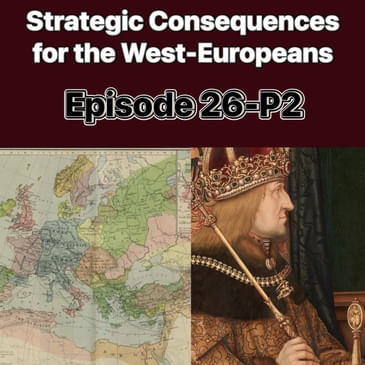
Episode Summary "Strategic Consequences for Europe"
- Timeline of Constantinople's Fall reaching the courts of Europe
- Reactions in Venice, Rome, Paris, and the Holy Roman Empire
- Duke of Burgundy attempts to start up another Crusade
- Silk Trade route consequences
- Age of Exploration spurred on by Ottoman Conquest of Constantinople
- Europeans Poles, Hungarians, Serbians, and Wallachians and Roman/Italian states brace for war against the Ottoman Empire int he Balkans
Thoughts? Feedback? Email Frank at empiresofhistorypodcast@gmail.com Visit the the Ottoman Empire Website and IMMERSE yourself in the Daily blog
TRANSCRIPT for this EPISODE HERE
[00:00:35] Hello and welcome back to Ottoman Empire Podcast. I'm Frank, your host. Please feel free to email me for feedback on these episodes. There's a link in the show notes. The very best way to support the Ottoman Empire Podcast is by
[00:00:51] signing up on my Patreon. There are two tiers available and they start at just three bucks a month. You'll get exclusive Patreon-only content, early access episodes, and so much more. Before jumping into the show, I would like to bring to
[00:01:09] your attention Laurie. She is the creator of Her Half of History, a wonderful podcast about women throughout time history. I started listening to it and right now I believe I'm on up to episode 40. It's a really, really intriguing
[00:01:27] podcast and I invite you to check it out. Also, Laurie was kind enough to head on over to Ottoman Empire Podcast.com and actually author an article for us. You can find a link in the show notes below. Thank you. European Strategic Consequences after the Fall of Constantinople 1453
[00:02:06] Episode 26 Part 2. In episode 26 part 1, we discussed the strategic consequences for the Ottoman Empire after their conquest of Constantinople. Now is time to switch gears since we'll be looking at the momentous event on May 29th of 1453 from the European perspective and from henceforth in this episode I'll be
[00:02:34] referring to it simply as the Fall. So during this episode when you hear me say the Fall, just know I'm talking about Constantinople after his conquest by the Ottomans. Before the past 11 centuries, the city of Constantinople had taken up permanent residence in the minds, dreams, and imaginations of
[00:02:57] Europeans. The city represented both the shining gem of Christendom and an outpost along the frontier of Islam, but it was also a stop-off point for mysterious adventures to the wider East. There were pamphlets, poems, and traveling minstrels in taverns who sang the songs telling that the streets were
[00:03:20] paved with gold, other crusaders stopping off in the first effort to retake the Holy Land and much, much more. The Byzantine or Eastern Roman emperors themselves were seen as a kind of archaic and esoteric infused half-human hybrid with divine power. The Latin West sacking of the city in
[00:03:42] April of 1204 marked not just the absolute ship point in relations between the Orthodox East and Latin West, but it was every bit a stumbling and grubby efforts of the West in ferriarty complex coming to bear. In the minds of the West, Constantinople would simply never fall.
[00:04:04] Sure, it would fall into the hands of Byzantine dynastic usurpers, and of course the Latin West managed to take the city through treachery, but that was all Christian powers just kind of minding their own business as far as
[00:04:19] the popular narrative went. But for an outside force, and one as damn right scary and alien as the Ottoman Empire, well, it's difficult to describe for you the psychological impact this had upon the collective outlook, culture, and socioeconomic behavior of the Europeans post 1453.
[00:04:43] The fall felt like for most people God had withdrawn his protection. I plan on doing a Patreon extra episode on the omens, visions, dreams, craze, saints, and mystic experiences which preceded the fall. But there was this fever dream, then nightmare of love, crafty and proportions, overcoming the
[00:05:07] collective European imagination. Not since the Native American mass and spontaneous ghost dances of the American late 19th century has such released religious fervor, overshot cultures, languages and political boundaries. The Europeans for a year after the fall lost their freaking
[00:05:29] minds. News of the fall reached Venice on Friday, June the 29th of 1453. This news took the form of official dispatches from the Constellation of Methone and from the Belio of Uboe. Rome learned on July 8th that same
[00:05:48] year from official envoys from Venice, while the Genoese learned of the fall sometime around July 10th. From Rome, Venice and the Genoese, the news spread up from the Italian peninsula and into the German states, from the German states, and then into Burgundy it managed to work its way
[00:06:10] into the rest of France. The Hungarians, who had been keeping close tabs via the spies and envoys of Hunyadi, were able to learn of the news quicker than most, but they sat on the news for a while. The Polish
[00:06:25] kingdoms in Middle Austria learned of the fall in July and August. However, by the end of 1453, all of Europe was now aware of the fall, end of the Pelagian dynasty and whose forebearers just decades ago, the noblemen of Europe recalled the Byzantine emperors visiting their
[00:06:45] courts and asking for aid. After the news came a slight flood of civilian refugees. Some were survival of the fall with limited firsthand accounts, of which almost none of which have managed to come down to us. Others were the military mercenary units
[00:07:03] employed to fight the Ottomans advances into Wallachia after Mademons victory. As Mademons moved up from Constantinople the following years and brought war into the Balkans, there would be still more refugees flooding first Hungary, then up in Napoleon, and then especially they would make their way down the
[00:07:22] Italian peninsula to Rome itself. All of these refugees carried with them what we would later call in history, the Stoud, the Val Turk, an image of a rapacious beast, brief of rational thought and bent upon only slaughter. An Ottoman demon whose only success
[00:07:43] upon the battlefield wasn't due to European incompetence or cowardice, but because the Val Turk has cemented a magical pact with none other than Satan himself as punishment for Europe's sins. Holy Roman Emperor Frederick III was informed in the fall on
[00:08:03] July the 12th, and the embellishment went that the Turks had massacred all 40,000 inhabitants of Constantinople. The last emperor of the Byzantines, Constantine, also, of course, as these rumors go, had secretly married. And no listeners, he didn't do this, in fact he was never married, but this is
[00:08:24] how European best gets fun. The rumor went that Constantine had a beautiful princess as a daughter, and she was the product of this mysterious union and was currently hiding in Greece, awaiting a valiant Christian knight to rescue her. Frederick
[00:08:41] III, along with Philip the Good of Burgundy, began to talk amongst themselves and private correspondents about what exactly if anything could be done against the Ottomans. In fact, a guy named Cardinal Isidor, a first hand account survival of
[00:08:59] the fall, of which is covered in my source material for these episodes, was traveling around the various courts spinning tells of Helen of Troy and trying to spin the fall into a new legend. Fanning the flames were ambitious churchmen already
[00:09:16] clamoring for another crusade to liberate the city. Philip the Good of Burgundy wasted no time and created an order called the Golden Fleece. And in a dramatic ceremony, his knights took the oath of the pheasant and pledge holy war against the Ottoman
[00:09:33] Empire, in much the same vein as the order of Lord Dracula, the third joined the order of the dragon. All over Europe, the grief was giving way to nightmares of an Ottoman advance through the Balkans and into central then Western Europe. There
[00:09:51] was still a sizable and threatening grouping of Muslim territories in Spain. The 700s, Umayyad Muslim caliphate invasion of France was still talked about in poem and song and preached about during mass. Now it seemed like the grief nightmares were turning into fancy. Off to the
[00:10:13] sidelines and remaining very, very quiet were the Venetians. They were notably absent from the courts of Burgundy, France, the Holy Roman Empire, and down in Rome where the fires for another crusade were burning. More than anyone saved probably the Hungarians. The Venetians had a firmer grasp upon the
[00:10:34] strategic and tactical situation on the ground than the rest of Europe. They had fought with, traded with, signed treaties with, helped defend Constantinople, and now we're left with two very grim facts about the Ottoman Empire. First, it wasn't a matter of if but when the Ottomans came
[00:10:57] attacking their holdings which dotted the Eastern Mediterranean. They still had the island of Rhodes and many other important traded outposts, all of which they knew they would have a hell of a time defending when the powerful Ottomans came unknocking. Second, the Ottomans would be
[00:11:16] advancing up the Balkans. Maybe not today, maybe not tomorrow, maybe not next month but a general advance was to be expected. This would mean that the Ottomans would control more and more coastline and also a bunch of outposts along the Adrienne Sea. This meant Venice itself could
[00:11:36] be raided, attacked, or lord forbid perhaps even sacked by a sizable Ottoman contingent. And speaking of contingent or more specifically the Ottoman Navy, sure some clunky old Christian ships had beaten the Ottoman naval blockade around Constantinople and the Ottomans had like what two
[00:11:58] major naval defeats under their belt now. Yet despite of these defeats or maybe it was because of them the Venetians observed the Ottomans rebounded their navy each time and each time they came back from a defeat their navy had this
[00:12:16] bad habit of getting bigger and better than before. Now with the fall and the control of the Silk Road this meant the Ottomans were about to get stinking rich and when you're rich and you want to build a powerful navy you can recruit
[00:12:32] the most talented shipbuilders navigators and experts to your cause. Yep so things were looking pretty grim from the Venetian side of things. The Venetians then stayed out of the many discussions among the Europeans for another crusade. Let the folly fall on someone else's
[00:12:51] shoulders so the reasoning went. Instead Venetian envoys put feelers out to man the second this new conqueror of Constantinople. They wanted to see what kind of mood he would be in to renew the peace treaty they had signed with
[00:13:08] the Sultan back in 1451. If you recall this treaty in my previous episode it was basically an agreement between the Ottomans and Venetians to let Venetians ship sail without being harassed across the Turkish straits going to and from the Black Sea and generally able to conduct
[00:13:28] trade all for small sum of protection money to be paid directly to the Sultan. Mehmed luckily for the Venetians was in a really good mood that summer of 1453 and he was also interested in keeping the Venetian sideline for the moment because he was thinking about building up
[00:13:50] his navy. He happily therefore signed their requested treaty all of this the Venetians preferred to keep quiet and not really tell their European friends and allies. Venice however wasn't the only power taking a hardboiled egg approach to the fall either. Twittling their
[00:14:10] thumbs was Portugal already shut out of lots of trade in the Mediterranean thanks to the erstwhile friends the Genoese and the Venetians. They began throwing around the idea of well maybe finding a different maritime base route of getting to India and what if what if Portugal
[00:14:31] managed to circumvent the whole Ottomans and their Christian competitors in the region all together. Realizing what the Portuguese were up to Venice didn't want to be left out of the game and pretty soon you had a slew of European maritime powers beginning to finance expeditions that could
[00:14:51] explore a possible passage around the Ottoman Empire. And thus we have borne the age of exploration getting off to a sputtering start in 1453 through 1460 but it was a start nonetheless and a direct consequence of the fall of Constantinople. From 1453 if we fast forward our time
[00:15:16] machine 39 years we will find a man by the name of Christopher Columbus and bam you have the discovery of the North American continent. In part one of this episode I talked about some myths that surrounded the Ottoman conquest of Constantinople namely the atrocities
[00:15:34] committed by Ottoman troops and while we explored the fact that atrocities did happen they most likely didn't happen on the massive scale that YouTube videos love to talk about. Another myth of the fall of Constantinople from the European side
[00:15:51] is this lingering idea a myth if you will and I would like to bust this right now that the fall of Constantinople resulted in the Renaissance in Europe or at the very least its beginning. The argument goes kind of like this a bunch of Byzantine refugees
[00:16:11] fled the capital after the fall and these refugees were composed of philosophers a superb educated class and they would later kind of fan out into the major cities of Europe and tucked underneath their arms were Socrates, Plato, Aristotle, math, physics and medicine
[00:16:30] and thus we have the beginnings of the Renaissance. Now I know that I am given a criminal argument or a straw man of this view but I just want to address this this is not the case at all.
[00:16:44] First of all there were very very few people from the eastern Roman state which made it directly out of Constantinople. Most of the refugees who were fleeing were very poor and ignorant kind of folk they definitely didn't have Socrates tucked under their arms
[00:17:01] plus most of the writings and intellectual books they were either captured sold or destroyed by the Ottomans so very very few texts directly made it from the Byzantine Empire to the West at least in any kind of meaningful form instead here's what most historians
[00:17:19] think happened. With the ascension of the Ottoman Empire in the eastern Mediterranean and their absolute monopoly over the trade routes you suddenly had other Islamic powers such as located in Egypt, North Africa, Syria and Persia began trading a bunch of books
[00:17:37] about you guessed it Socrates, Aristotle and philosophy, math and science. It was through this Islamic trade that Europe was able to really kind of get the Renaissance kick started and that too is a bastardization of that argument I just didn't want to get
[00:17:55] too far into it so with that thrown out there thank you for listening when we pick up next we're going to get into the military campaigns of Mehmed II and we're going to get back into the regular
[00:18:07] progression of the Ottomans I'm looking forward to it and I hope you are too thank you